An art robot can repeat a line, move a brush through a planned path, or turn digital instructions into marks on a physical surface. Its main effect starts earlier, when the artist has to describe an idea as coordinates, tool movements, materials, and limits.
That shift matters to artists deciding whether a robot belongs in the studio. The machine may widen the range of forms they can make, but it also adds setup, testing, safety checks, and technical choices.
Quick read
- Robots repeat movement: A programmed arm can follow the same path across many pieces.
- The tool shapes the result: A brush, pen, spray head, cutter, or gripper leaves a different kind of mark.
- The artist still sets the rules: The robot follows code, sensor input, or a person’s commands.
The robot turns ideas into movement
Traditional tools respond directly to a person’s hand. An art robot adds a layer between the idea and the mark: software turns a drawing, pattern, or set of coordinates into instructions for motors.
That layer changes the work. The artist must decide how fast the tool moves, how far it travels, how much pressure it applies, and what happens when the material behaves differently than planned. A line on a screen becomes a real path with limits.
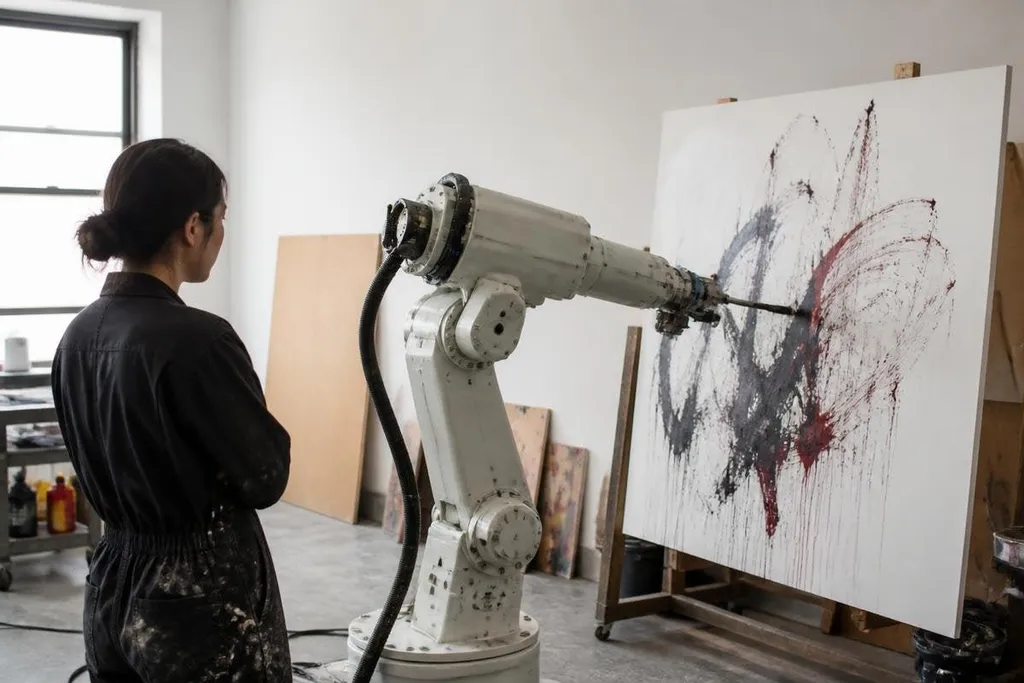
A robotic arm can repeat a programmed motion with little change from one pass to the next. This suits work built from patterns, large-scale drawings, precise cuts, or repeated marks. It can also expose small errors in the plan, since a robot will follow poor instructions with the same care as good ones.
The physical tool still matters. A pen makes contact at one point. A brush bends and spreads. A spray head changes the surface without touching it. The arm may be the visible part of the system, but the end effector, meaning the tool fixed to its wrist, often controls the look of the finished piece.
Control can be shared
Artists can write the instructions, adjust them while the robot runs, or guide the machine through teleoperation. Teleoperation means a person controls the robot from another interface rather than moving the tool by hand.
Each method gives a different kind of control. Code makes repetition easier. Direct guidance keeps more hand movement in the process. Sensors can let the robot react to distance, contact, or changes in the surface instead of following one fixed path.
That shared control makes authorship harder to describe in one sentence.
The artist may choose the rules, the material, and the limits, while the robot handles the physical motion. Software may add another layer by changing paths or patterns before the robot begins.
This is why the phrase “robot-made art” can hide more than it explains. A finished image doesn't show who set the path, who chose the tool, or how many failed attempts came before it.
The control system sets the robot’s options before the first line appears. Reporting from Robot 24 can place that system, the chosen tool, and the test setting beside the finished work, so you can see where human choices end and machine limits begin. Those limits shape the medium.
The limits are part of the medium
Robots repeat instructions well, yet repeatability doesn't guarantee a good result. A surface can bend, paint can dry, a tool can slip, and a sensor can read the material incorrectly. These events force the artist to decide which errors belong in the work and which require a new setup.
The robot also needs space, power, software, and a safe operating area. A robotic arm near people needs clear movement limits and an emergency stop that can be reached during the task. Those needs shape the studio as much as the artwork.
Cost and access matter too. A setup may include the arm, controller, tool, mounting frame, software, and materials. A smaller plotter or converted machine may fit a personal studio better than an industrial arm, even if it offers fewer movement options.
I'd judge an art robot by the choices it gives the artist, not by how human its motion looks.
A practical studio checklist
Before choosing a robot for creative work, check these points:
- Name the motion: Write down the movement the machine must repeat or change.
- Choose the tool: Match the end effector to the surface, material, and mark.
- Test the failure: Run a small sample and record what happens when contact or alignment shifts.
- Set the boundary: Define the robot’s work area, speed limits, and emergency stop position.
- Keep the human role clear: Decide which choices belong to the artist, software, sensors, and robot.
The useful question is not whether a robot can make art without a person. It is which parts of making the work should become repeatable, adjustable, or deliberately unpredictable. That choice will shape the artwork before the first mark reaches the surface.